
Regional Fragrance Preferences for Pharmacy Chains: Six Mistakes to Avoid
Regional fragrance preferences are real, but they are usually misread as a question of taste alone. For a pharmacy own-label range they are also a question of climate, product format, dosage limits and how the shopper decides at the shelf. The six mistakes below account for most of the wasted sample rounds in this channel, and each one can be avoided with a short conversation before the brief is written.
Key takeaways
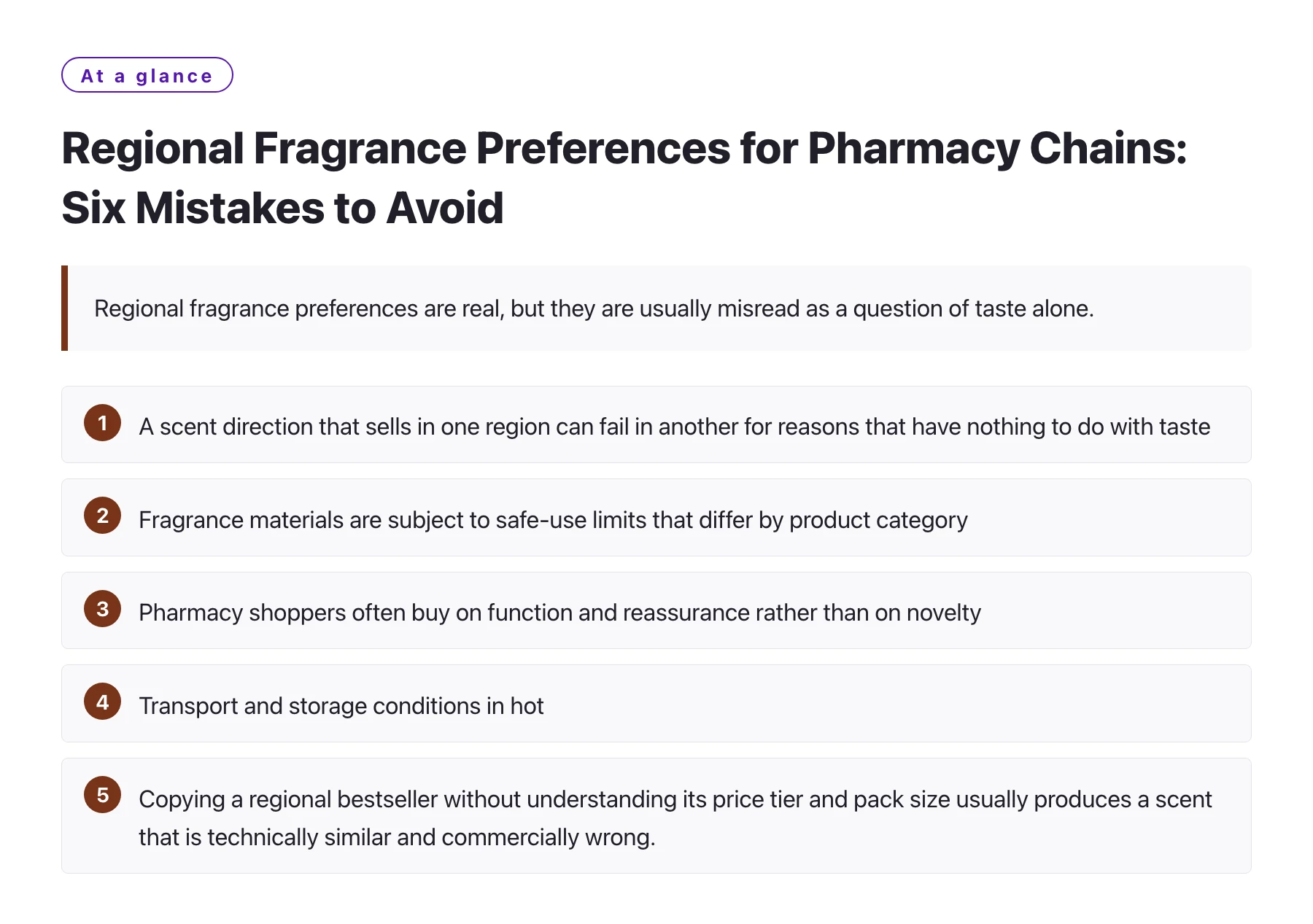
- A scent direction that sells in one region can fail in another for reasons that have nothing to do with taste, including climate, product format and the way the shopper is advised at the counter.
- Fragrance materials are subject to safe-use limits that differ by product category, so a formula built for fine fragrance cannot simply be poured into a body lotion.
- Pharmacy shoppers often buy on function and reassurance rather than on novelty, which changes how much complexity a scent can carry.
- Transport and storage conditions in hot, humid markets change how strong a fragrance smells when it reaches the shelf.
- Copying a regional bestseller without understanding its price tier and pack size usually produces a scent that is technically similar and commercially wrong.
- A market-by-market brief that lists format, climate, claims and documents is more useful to a factory than a mood board.
Ask five people in five countries to describe a fresh scent and you will get five different answers, all of them sincere. That is the part of regional preference work that everyone expects. The part that catches buyers out is everything around the scent: the format it goes into, the climate it travels through, the shelf it sits on and the documents the label has to carry.
Pharmacy own-label fragrance sits in an unusual position. It is bought in a store associated with health and advice, often at a price that makes it an easy addition to a basket, and frequently with a member of staff explaining what the product does. Those conditions reward clarity and punish anything that needs a paragraph of explanation.
The mistakes below are drawn from the pattern of briefs that go wrong. Each one is described with what it costs and what to do instead, because a preference brief is only useful if it can be actioned by a perfumer.
Six mistakes and what each one costs
| Mistake | What it costs a pharmacy range | What to do instead |
|---|---|---|
| Treating a scent profile as universally liked | A sample round that lands well in one market and reads as heavy, sharp or dated in another | Write the brief by market cluster, and say what each cluster should feel like in the first thirty seconds |
| Assuming fine fragrance formulas transfer to body care | Rework once safe-use limits and dosage are checked, plus a second sample round | Confirm the product category first, then check the applicable safe-use limits before the formula is finalised |
| Ignoring climate and transport | A fragrance that smells stronger or flatter on arrival than it did in the approval room | State the shipping and storage conditions, and judge samples after a heat cycle rather than straight from the box |
| Reading the pharmacy shopper like a department-store shopper | A scent that needs selling rather than explaining, which the counter cannot do in a short conversation | Keep the structure simple enough to describe in one sentence and test it with staff, not only with buyers |
| Copying a regional bestseller | A me-too product at the wrong price tier, with the wrong pack size and no reason to be chosen | Identify what the bestseller is doing for the shopper and brief the function rather than the fragrance |
| Leaving labelling and documents to the end | Late artwork changes, or a launch held while allergen and claim wording is corrected | Collect the market's labelling requirements at brief stage and design the pack around them |
Read the six rows as a single instruction: describe the market before describing the scent.
Why safe-use limits are the mistake that hurts most
A fragrance formula is not a fixed object that can be moved between products. The same concentrate is subject to different limits depending on whether it ends up in an alcoholic fine fragrance, a body lotion or a candle, and those limits exist to keep skin exposure within accepted levels. A brand that builds a body care scent on a fine fragrance formula may find the dosage has to be reduced, which changes how the product smells on the shelf. The International Fragrance Association publishes the standards that define these limits, and they are the first thing a formulator checks. [1]
This is where a regional brief and a technical brief meet. If the pharmacy range includes body care, the scent has to be built for body care from the start, at a dosage that is both permitted and commercially meaningful. Adding the format later forces a second development cycle, and the second cycle is usually the one that pushes a launch date.
Different markets, different documentation
Regional preference work often stops at the scent and restarts at the label, which is too late. Markets differ in how cosmetic ingredients are notified, how allergens are declared and what evidence supports a claim, and those differences have to be designed into the pack rather than patched after it. The European Commission summarises how cosmetics are regulated across the EU, and national authorities such as Health Canada publish their own cosmetic safety requirements, which is why a single pan-market label rarely works. [2]
Scientific opinion also moves. Committees such as the EU Scientific Committee on Consumer Safety review fragrance ingredients and publish opinions that can change what a formulator is willing to use, so a formula approved two years ago is not automatically a formula that will be approved next year. [3]
Writing a preference brief a factory can cost
A usable brief for each market states the product format, the price tier, the pack size, the climate the product will live in, the claims that will appear on the pack, and the feeling the scent should create in the first half minute. It also states what the scent must not do, because exclusions are often more useful than directions. A brief that says only light and fresh gives a perfumer nothing to reject. It is worth seeing how a manufacturer presents this route from market sheet to sample before you write yours, and the official Xuelei website sets out one version of that sequence.
If the range is being developed with a partner that handles both custom fragrance R&D and production, the brief can be worked through in one session with a formulator, which is usually faster than three rounds of email. Where the brief has to travel between several suppliers, keep the market sheet identical for each of them so that the quotes are comparable.
It also helps to decide early how much of the preference question belongs to the shopper and how much to the trade buyer. A pharmacy group buying for its own shelves is making a category decision, while a distributor is making a sell-through decision, and the two rarely want the same scent. Writing down which one you are answering prevents a brief that tries to satisfy both and ends up serving neither.
Finally, treat training as part of the regional package. A scent that has to be recommended at the counter works better when the people recommending it have smelled the alternatives and know why this one was chosen. That is the same skill a supplier develops when it teaches scent, and it is one reason a serious house will have a place to learn perfumery alongside its production. Where the market is large enough to justify a short internal session, budget for it at the same time as the sample round.
Do not let a preference discussion turn into a debate about personal taste. Bring the market sheet, bring two or three reference products that actually sell in that market, and judge the samples against the shopper described on the sheet. A perfumer can work with a target shopper; nobody can work with five opinions in a meeting room.
Sources
- IFRA Standards Library (International Fragrance Association) —— The IFRA Standards Library lists the restrictions the fragrance industry applies to individual fragrance ingredients, based on safety assessments; it is the reference point for compliant fragrance formulation.
- Health Canada: Cosmetic Safety —— Health Canada's cosmetics pages, covering cosmetic notification, the ingredient hotlist and safety requirements for cosmetics sold in Canada.
- EU Scientific Committee on Consumer Safety (SCCS) —— The EU scientific committee that issues opinions on the safety of cosmetic ingredients, including fragrance allergens and their labelling thresholds.
Frequently asked questions
Do regional fragrance preferences really exist, or is it just marketing?
They exist, but they are weaker than the marketing suggests and they usually work through climate, format and price tier rather than through nationality. Treat preferences as clusters of shopping behaviour and conditions, not as fixed national tastes.
Can I use one formula for a pharmacy range across several countries?
Often yes, if the range keeps to familiar fragrance families and the format stays the same. The formula may need dosage adjustment where safe-use limits differ by product type, and the labelling will almost certainly differ by market.
How many sample rounds should I budget for a multi-market range?
Two rounds is typical for a single-market range and three for a range covering two or three distinct clusters. Where formats differ, such as a fine fragrance plus a body lotion, budget separately for each format rather than assuming one round covers both.
What is the biggest mistake first-time buyers make with regional briefs?
Describing the scent instead of the shopper. A brief that says what the product must do, at what price, in what climate and for whom gives a perfumer far more to work with than a list of adjectives.
Should the same fragrance house handle several regions?
It is usually simpler. One partner that can hold the market sheets side by side keeps formulations, changes and documentation in one place, which reduces the chance that two versions of a similar brief drift apart.
Take the next step with Lake Norman Soccer.
Join 250+ players in the region's most established competitive youth soccer pipeline, guided by 17 licensed UEFA and USSF coaches.